

Post-Webinar Insights from the Eighth #LearnWithPukunui Webinar: Exploring Reflective Practice, Learner Ownership and Practical Strategies for Meaningful ePortfolio Learning
Student engagement is often measured through attendance, participation, assignment submissions and activity completion. While these indicators provide useful information, they do not always reveal how deeply learners are thinking about their experiences or connecting what they have learned to the world beyond the classroom.
What if engagement could also be demonstrated through reflection, personal growth, collaboration and the ability to explain the value of one’s learning?
This was the central focus of Pukunui’s eighth #LearnWithPukunui webinar of 2026, Using Mahara to Foster Deeper Student Engagement, featuring Kristina Hoeppner, Project Lead of the Mahara ePortfolio project at Catalyst IT, New Zealand.
Unlike an introduction to Mahara’s features and functionality, this session focused on the pedagogical side of ePortfolios: how educators can design meaningful portfolio activities that encourage reflection, learner ownership and deeper engagement.
What Does Meaningful Student Engagement Look Like?
The webinar began with a question for participants: How do you know your students are engaged in learning?
Responses included observing students’ body language, receiving feedback, and seeing learners actively answer questions or participate in discussions.
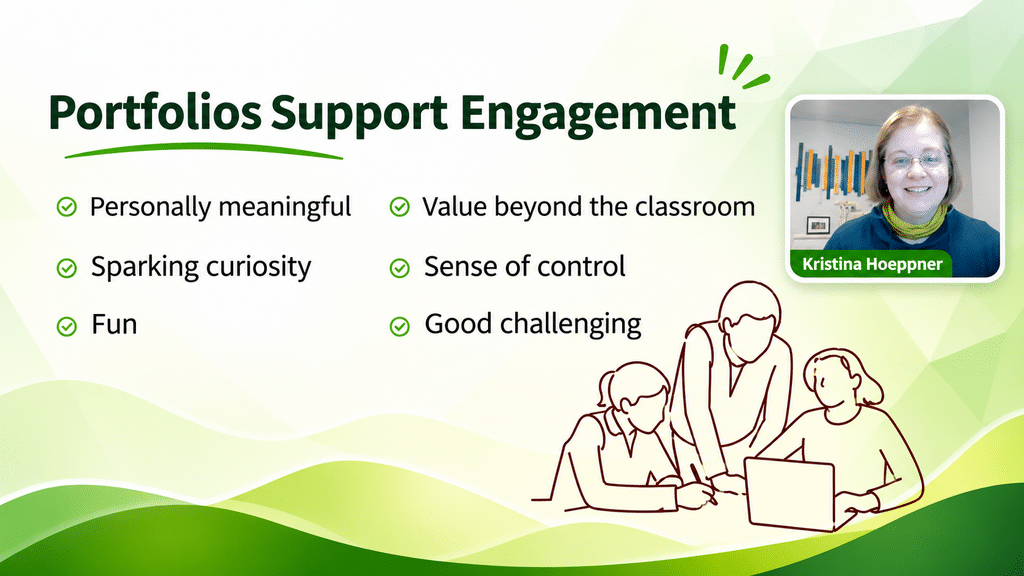
Kristina expanded on these observations by highlighting several characteristics of meaningful engagement:
- Learners find the content personally meaningful and relevant.
- They understand the value of what they are learning beyond the classroom.
- Their curiosity and interest encourage them to explore topics further.
- They have a sense of control over their learning.
- They find learning enjoyable and appropriately challenging.
- They actively participate by asking questions, sharing ideas and responding to others.
These qualities are particularly relevant to ePortfolio practice. When learners have opportunities to select evidence, reflect on their experiences and communicate their achievements, they become more active participants in the learning process.
Rather than simply completing tasks assigned by an educator, learners begin to consider what their experiences mean and how they contribute to their personal and professional development.
Understanding the Different Purposes of ePortfolios
An ePortfolio is not limited to showcasing completed assignments. Its purpose can vary depending on the learning context and intended outcomes.
During the session, Kristina introduced five common types of portfolios.
1. Learning Portfolio
A learning portfolio allows individuals to document their experiences, personal reflections and ongoing learning. It can be a private space where learners make sense of what they have learned without necessarily sharing it with others.
2. Assessment Portfolio
An assessment portfolio is used to demonstrate achievement against formal learning and assessment requirements. It can be integrated into a course and assessed as part of the learning process.
3. Work-Integrated Learning Portfolio
For internships, practicums and workplace learning, portfolios provide a way for learners to document their experiences and reflect on their practical application of knowledge. Educators and workplace mentors can also be invited to view the portfolio and provide feedback.
4. Showcase Portfolio
A showcase portfolio allows learners to present their skills, achievements and development. It can support job applications, career progression and applications for further study.
Reflection can also strengthen a showcase portfolio by demonstrating how a learner has developed from one stage to another.
5. Professional Certification Portfolio
Professional certification portfolios provide evidence against competency frameworks and professional requirements. They allow individuals to explain why they believe they have achieved particular competencies rather than simply indicating that a requirement has been completed.
These examples demonstrate that portfolios are not exclusively for students. They can also support educators, working professionals and anyone involved in formal, non-formal or informal learning.
The Five Cs of ePortfolio Learning
A key framework introduced during the webinar was Mahara’s Five Cs: Create, Collect, Curate, Converse and Collaborate.
These five activities help explain how learners move beyond simply collecting their work towards reflection, dialogue and shared learning.
Create
Learners produce learning artefacts such as presentations, projects, reports, performances or other completed activities.
Collect
Learners gather these artefacts in their portfolios, creating a record of their learning experiences.
Curate
Learners select, organise and reflect on their collected work. This is where they begin to make sense of their experiences and explain what they have learned.
Converse
Learners engage in conversations with educators, peers, mentors and other individuals. Feedback and discussion introduce different perspectives and help deepen understanding.
Collaborate
Learners work together on shared portfolio activities. In Mahara, group portfolios provide opportunities for collaborative work and assessment.
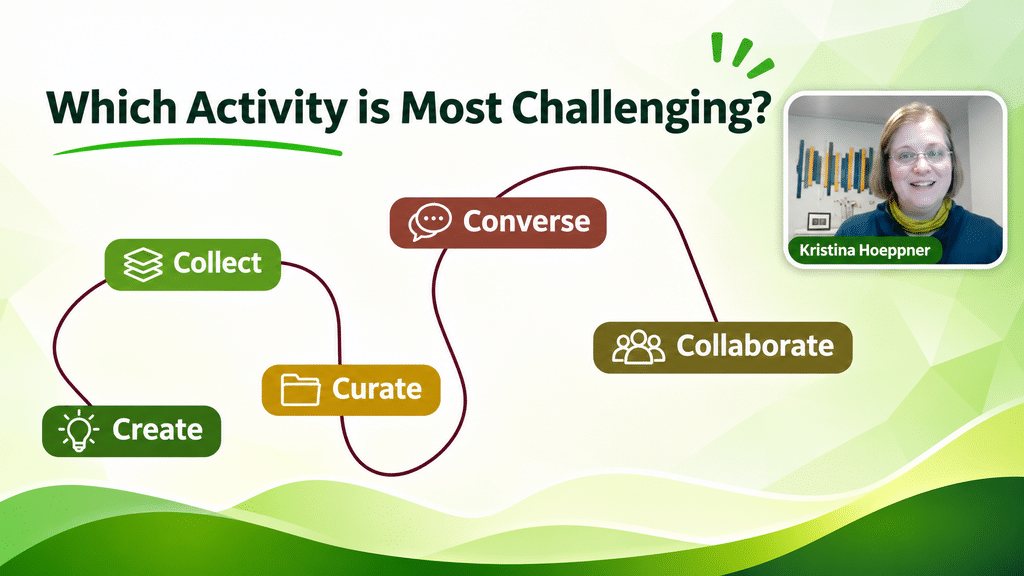
Of these activities, Kristina identified curation as particularly challenging because it requires learners to move beyond describing an experience towards critically examining its meaning.
From Learning Artefacts to Meaningful Evidence
One of the useful concepts discussed during the webinar was the difference between an artefact and evidence.
An artefact is something a learner produces, such as a presentation, project or written assignment.
Evidence goes further. It connects the artefact with reflection, explaining what the work demonstrates and why it matters.
For example, uploading a completed group presentation into an ePortfolio creates a record of the activity. Adding a reflection about the learner’s contribution, challenges encountered, feedback received and lessons learned turns that artefact into more meaningful evidence of development.
This process helps learners communicate not only what they have accomplished, but also how their knowledge, skills and understanding have evolved.
Building Reflective Habits into Everyday Learning
Reflection was one of the strongest themes throughout the webinar.
Kristina emphasised that reflection should not be treated as an occasional exercise completed at the end of a course. Instead, educators should help learners develop regular reflective habits.
Reflective practice can support self-awareness, help learners recognise their progress, improve decision-making and provide opportunities to process challenging experiences.
Several practical approaches were shared during the session.
Allocate Time for Reflection During Class
One example discussed was a lecturer who reserves ten minutes at the end of a class for students to work on their portfolios.
This gives learners dedicated time to reflect while their experiences are still fresh, rather than leaving the activity entirely for them to complete outside class.
Encourage Regular Reflection
Reflection can become a weekly activity or a regular part of a learner’s routine. The time required can vary depending on the experience or topic being considered.
Use Guided Questions
Providing three to five questions can help learners focus their reflections. Questions should be relevant to the learning activity and encourage learners to examine their decisions, experiences and understanding.
Introduce Reflection Partners
Conversations with peers, educators or mentors can help learners consider different perspectives. A trusted reflection partner can also ask follow-up questions that encourage deeper thinking.
Embed Reflection into Learning Activities
Reflection becomes more meaningful when it is connected to coursework, projects and practical experiences.
For example, learners can be asked to connect theories covered in their readings with their own personal or community experiences.
These approaches help make reflection part of the learning process rather than an additional task.
Using AI to Support Reflective Practice
The webinar also explored how AI-powered tools can support reflective conversations.
Kristina introduced Riff, a reflection-focused chatbot developed by Dr Leticia Britos Cavagnaro at Stanford University’s d.school.
Rather than simply providing answers, Riff encourages learners to explore their thoughts through questions. It can also revisit previous responses and continue the conversation, helping learners examine their experiences from different perspectives.
Another example discussed was the use of reflective prompts through tools such as OpenAI’s resources for reflection.
However, AI-supported reflection requires careful consideration. Learners may share personal or sensitive experiences during reflective activities, so educators should discuss privacy, data security and the appropriate use of these tools before introducing them.
AI can support the reflective process, but it should not replace the learner’s own thinking or judgement.
Supporting Reflection Through Mahara
The webinar also demonstrated several ways Mahara can support reflective learning through its portfolio features.
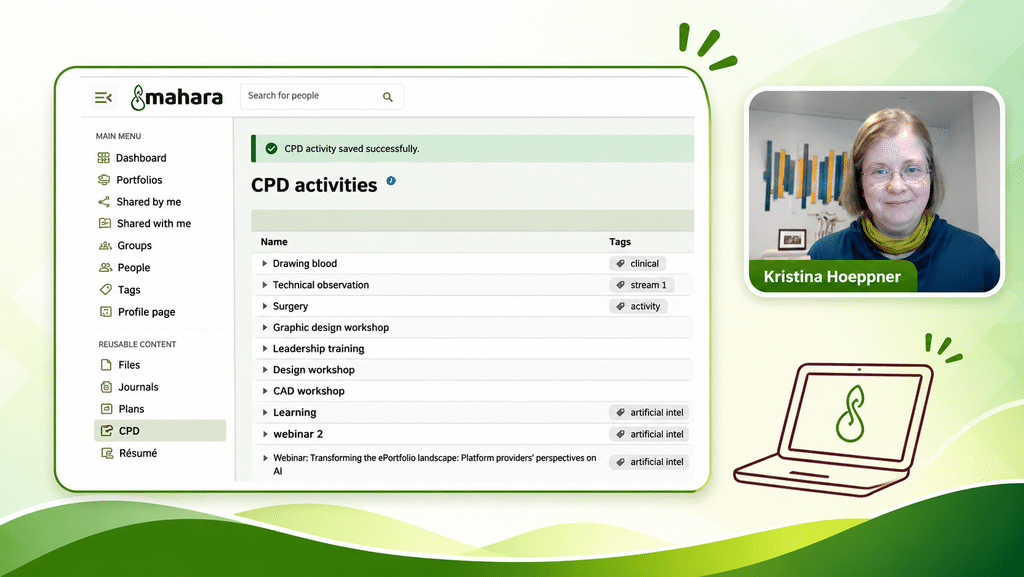
Continuing Professional Development (CPD) Activities
Mahara allows learners to record CPD activities with information such as titles, categories, dates and time spent.
A reflection field can be included alongside the activity, helping learners capture what they have learned while the experience remains fresh.
These records can subsequently be incorporated into portfolio pages to demonstrate professional growth.
Journals and Multimedia Reflection
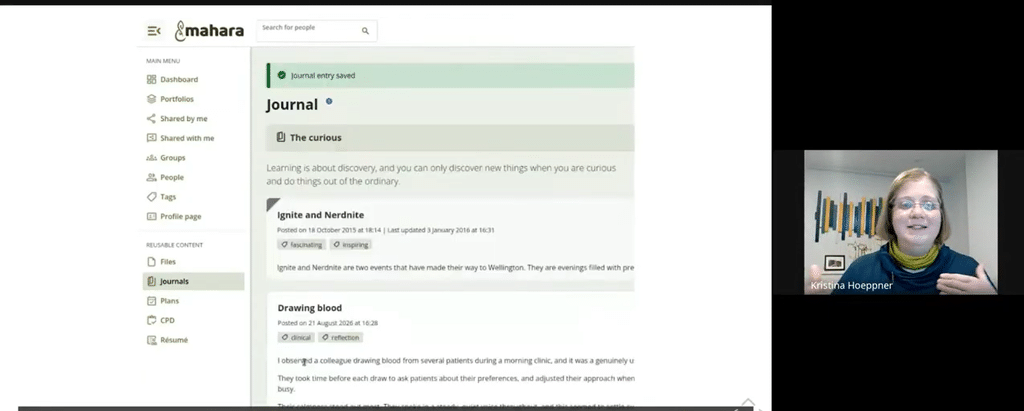
Journals provide a space for learners to record reflections and organise entries using tags.
Kristina also demonstrated that Mahara 26.04 supports recording audio and video directly through the visual editor.
This offers alternatives to written reflection, allowing learners to communicate their experiences through different media.
Self-Assessment and Peer Assessment
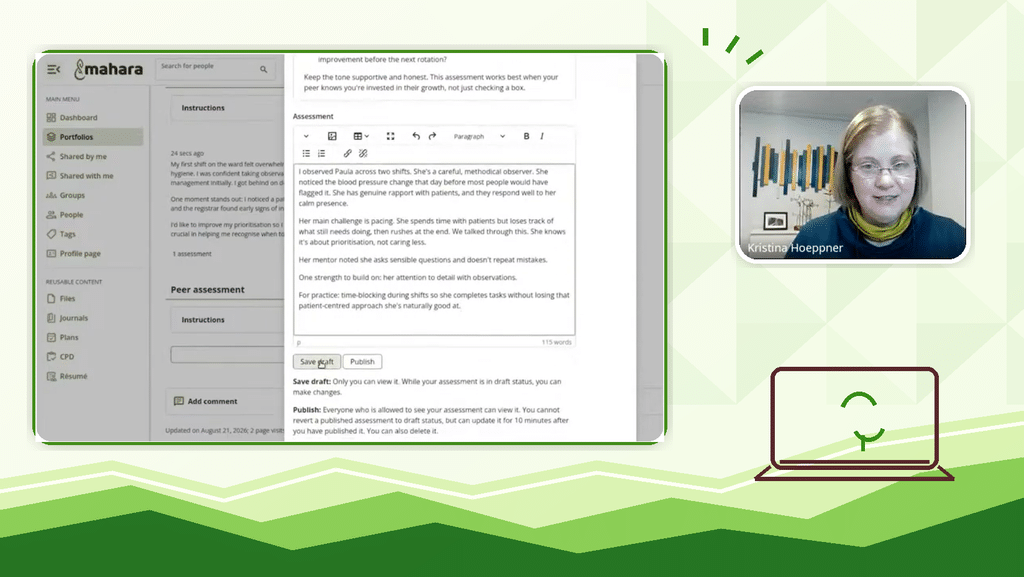
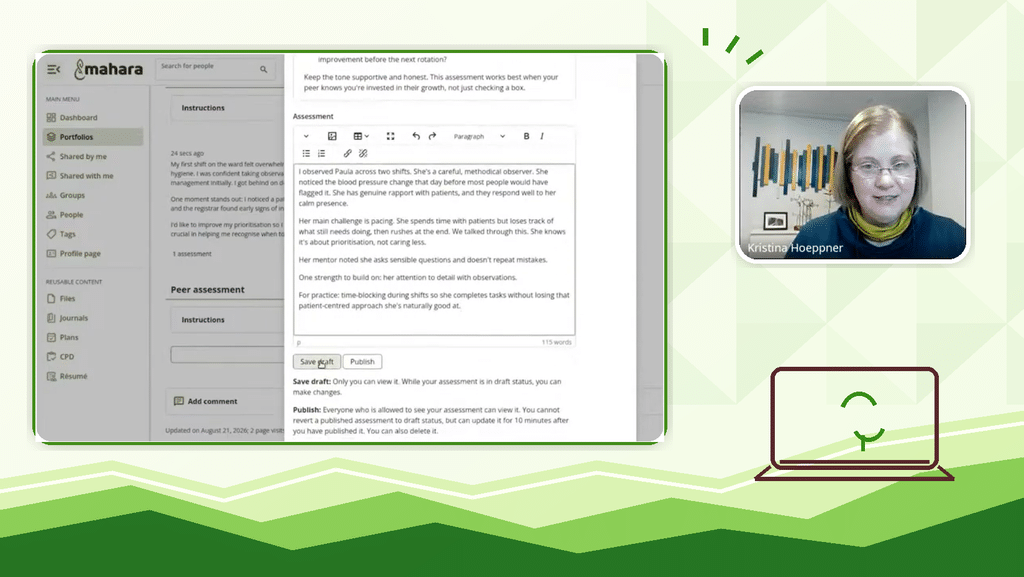
Mahara’s assessment blocks can display instructions alongside the learner’s reflection, making it easier to refer to the relevant requirements while completing an activity.
Peer assessment provides opportunities for learners to receive feedback from others. Reviewers can prepare their responses as drafts before publishing them for the learner to see.
These features support the conversational and collaborative dimensions of portfolio learning.
Using Templates to Guide Learners
For learners who are unfamiliar with ePortfolios, being asked to create a portfolio from scratch can be overwhelming.
Kristina discussed how portfolio templates can provide structure and guidance, helping learners understand what is expected.
Templates can include instructions, suggested sections and activities while still allowing learners to personalise their work.
The goal is not necessarily to prescribe every detail. Instead, a well-designed template can provide enough guidance to help learners get started while preserving opportunities for creativity, individual reflection and personal expression.
Kristina described templates as an invitation: they provide a starting point, but learners can expand on the content and make the portfolio their own.
This approach can help reduce the feeling of starting with a blank page, particularly for learners who are new to portfolio-based learning.
Making Progress and Competencies Visible
Another important aspect of engagement is helping learners recognise their progress.
Mahara includes features that support this through portfolio completion tracking and SmartEvidence.
Portfolio Completion
Portfolio completion provides an overview of which portfolio pages have been completed and which still require attention.
This helps learners manage larger portfolios, identify outstanding activities and decide where to continue their work.
SmartEvidence
SmartEvidence allows portfolio pages to be associated with competency frameworks, supporting the assessment of demonstrated capabilities.
Kristina explained that SmartEvidence can involve multiple assessors, including the learner, providing different perspectives on competency development.
These features are particularly relevant to programmes that require learners to demonstrate progress against specific skills, competencies or professional standards.
Implementing ePortfolios: Start with Pedagogy, Not Technology
A central message from the session was that successful ePortfolio implementation requires more than introducing a new platform.
Educators need to begin by considering their learning objectives and how portfolio activities will support them.
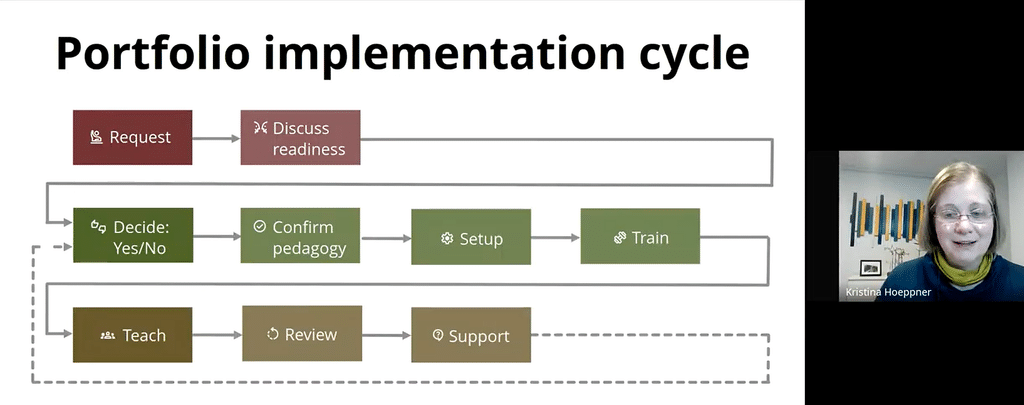
Kristina introduced a portfolio implementation cycle that encourages institutions to consider the following stages:
- Assess readiness: Determine whether the institution, educators and learners are prepared to introduce portfolio-based learning.
- Confirm the pedagogy: Identify the intended learning outcomes and how portfolios will fit into the wider curriculum.
- Design activities: Plan the portfolio structure, activities and assessment requirements.
- Provide training: Support educators and learners in understanding how to use portfolios effectively.
- Implement portfolio learning: Introduce the activities into the teaching and learning process.
- Review and improve: Evaluate the implementation, identify areas for improvement and make adjustments for future use.
This iterative approach helps educators refine portfolio activities based on experience and feedback.
It also highlights the importance of supporting both educators and learners through appropriate training and guidance.
An ePortfolio is most effective when its purpose is clear and its activities are meaningfully connected to the wider curriculum.
Key Takeaways for Educators and Learning Designers
The webinar offered several important insights for educators considering ePortfolio-based learning.
1. Engagement goes beyond participation. Meaningful engagement involves curiosity, personal relevance, learner ownership and the ability to connect learning experiences.
2. Reflection transforms artefacts into evidence. Collecting work is only the beginning; learners need opportunities to explain its meaning and demonstrate growth.
3. Reflective habits require intentional design. Regular, guided reflection can be more meaningful than a single end-of-course reflection activity.
4. Portfolio templates provide valuable scaffolding. Clear guidance helps learners get started while leaving room for personalisation.
5. Feedback and collaboration strengthen learning. Conversations with educators, peers and mentors can introduce new perspectives and encourage deeper thinking.
6. Technology should support pedagogical goals. Features such as journals, CPD records, peer assessment, portfolio completion and SmartEvidence become valuable when aligned with clear learning outcomes.
Ultimately, fostering deeper student engagement is not about introducing more activities or technology. It is about creating opportunities for learners to understand their experiences, recognise their development and take ownership of their learning journey.
Watch the Webinar and Get Your Certificate!
Interested in discovering how Mahara can support more reflective, engaging and learner-centred educational experiences?
Watch the recording of Using Mahara to Foster Deeper Student Engagement, featuring Kristina Hoeppner, to explore the pedagogical strategies, examples and Mahara demonstrations shared during the session.
Participants who attended the live webinar can request a certificate of participation through the form or QR code provided during the session. For assistance with certificate requests, please contact Pukunui.
For institutions exploring Mahara ePortfolio implementation, integration with their learning environment or portfolio-based assessment strategies, Pukunui can provide consultancy and support.
Contact Pukunui Malaysia: hello.my@pukunui.com
#LearnWithPukunui is Pukunui’s webinar series connecting educators, learning designers and technology specialists to explore practical strategies and innovations in digital education.
